How to Do a Jigsaw Puzzle in Bed Without Losing Pieces?
A puzzle table for bed works best when it sits on a firm surface, with pieces kept in shallow trays and the puzzle covered before you move or sleep. Choose a board or tray that fits your puzzle and leaves room for your legs.
On this page (6 sections)
- How do you set up a puzzle table for bed?
- How can you keep pieces from disappearing into bedding?
- What should you do before moving or covering the puzzle?
- How can you make the puzzle easier to see in bed?
- What position makes bed puzzling more comfortable?
- How do you keep the bed setup tidy between sessions?
A puzzle table for bed can keep a jigsaw above the bedding and its pieces within reach. Use a stable board or tray, sort loose pieces into shallow containers, and cover the puzzle before moving it or turning in for the night.
Choose a surface that fits the puzzle and leaves space for your legs. If you need to pause often, look for a cover or a case that keeps the work together.
How do you set up a puzzle table for bed?
Set the puzzle table on a firm, level spot and keep it away from the mattress edge. Before placing pieces on it, gently check whether the surface shifts when you move your legs or reach across it.
Clear blankets and pillows from the work area. Fabric folds can hide small pieces, and a crowded surface makes it easier to brush pieces onto the bed.
Measure the puzzle board and your available bed space first. A surface that fits the puzzle may still feel cramped if it blocks your legs or sits too close to the edge.
Should a puzzle table for bed have legs?
A table with legs may raise the puzzle above the bedding, but its footprint and height need to suit your mattress and posture. Check whether the legs rest securely before setting up the puzzle.
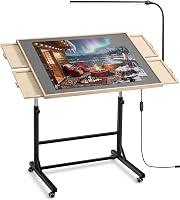
The RAGOZONERY Tri-Height Puzzle Table has three use modes, including a raised setting for bed or couch puzzling, a lower floor setting, and a flat board mode for another table. It measures 35 x 26 in and includes a protective cover.
The table has five tilt settings and a detachable support bar. Consider the weight and dimensions before carrying or positioning it on a bed.
For a broader comparison of raised and tabletop options, see jigsaw puzzle tables by type. If your bed setup needs a different surface, puzzle tables for the couch explains what to check over a lap.
Is a bed tray wide enough for your puzzle?
A bed tray can work when its top supports the whole puzzle board without pieces hanging over the sides. Compare the usable surface with your board, not just the puzzle’s finished dimensions.
The SAIJI XX-Large Foldable Bed Tray has a 25.6 x 19.3 in top and fixed legs. Its listed height is 10.6 in, and it folds for storage.
The tray’s legs are fixed, so check the height and clearance against your bed. Keep the board centered, and avoid leaning on the tray while reaching for pieces.
If you’re choosing between an over-bed surface and a lap tray, compare the tradeoffs in puzzle table or lap tray.
How can you keep pieces from disappearing into bedding?
Keep unsorted pieces in shallow trays or small containers instead of spreading them across blankets. Sort by color, edge, or a clear section of the image, and leave space between groups so pieces are easy to pick up.
A board with sides or drawers can help contain pieces, but it won’t make a loose setup spill-proof. Keep containers away from the edge and close them before shifting the table.
The PAZIONMI Small Lap Puzzle Board measures 18.1 x 14.4 in and has two storage drawers with magnetic closures. Its size is intended for smaller puzzles, so check your puzzle’s working area before choosing it.
This board may suit a small project that can fit within its surface. It may be too small for a larger puzzle or for sorting many groups at once.
For more ways to keep pieces grouped between sessions, see puzzle storage ideas.
What should you do before moving or covering the puzzle?
Before moving the table, remove loose pieces from the edge and cover the puzzle. Lift the surface evenly, keeping it level, and avoid turning or tilting it unless the setup is designed for that movement.
A padded case can make it easier to store a puzzle flat between sessions. The Lavievert 1000 Board in a Padded Case is sized for puzzles up to 1,000 pieces and includes four sorting trays, a detachable board, and a padded case.
This board measures 30.71 x 20.87 in and is designed for tabletop use. It is a separate board and case, so it won’t raise the puzzle above the bed like a legged tray.
If your puzzle is already assembled and needs to move, follow how to move a puzzle without breaking it apart. For a board designed to close over a puzzle, compare wooden puzzle boards with covers.
How can you make the puzzle easier to see in bed?
Use a lamp that lights the puzzle evenly without shining into your eyes. Place it to one side and adjust its angle if your hand casts a shadow over the area you’re working on.
A bright patch on a smooth surface can make colors harder to distinguish. Try moving the lamp, changing its angle, or using a softer room light alongside it.
For more placement ideas, read what light is best for doing puzzles. If a built-in light is part of your setup, puzzle tables with lights covers the tradeoffs.
What position makes bed puzzling more comfortable?
Choose a position that lets you reach the middle of the board without leaning far forward or twisting. Move the board closer when needed, and take breaks if you feel stiff or tired.
A raised surface can reduce the need to hold a board on your lap, but the right height depends on your bed and how you sit. Keep drinks and other items off the puzzle surface to reduce bumps and spills.
How do you keep the bed setup tidy between sessions?
Put sorted pieces in trays, cover the puzzle, and store small loose items before you sleep. Keep the board flat if the pieces are not secured, and follow any cover or case instructions for moving it.
Choose a setup based on the main constraint: use a legged table if you need clearance above bedding, a broad bed tray if its fixed height fits, or a padded case if storage between sessions matters most. For an ongoing project, a protective cover and nearby sorting trays make it easier to stop and resume without scattering pieces.
Frequently asked questions
Can you do a jigsaw puzzle in bed?
Yes, you can do a jigsaw puzzle in bed if you use a broad, stable surface and keep loose pieces in shallow trays. A bed tray or puzzle board can hold the work above the bedding, but check that its legs sit securely and leave enough room for your legs before starting.
How do you stop puzzle pieces from getting lost in bed?
Keep pieces on the board or in sorting trays, and cover the unfinished puzzle before you shift the tray or go to sleep. Avoid working directly on bedding, where pieces can slide into folds, and check the surface and surrounding blankets before moving anything.
Is a laptop bed tray suitable for a jigsaw puzzle?
A laptop bed tray may work for a small puzzle if its usable surface fits the board and the legs sit firmly on your bed. Many trays have fixed legs, so compare their height and width with your bed setup, and keep the puzzle away from the edge.
What light should you use for puzzling in bed?
Use a nearby adjustable lamp that lights the whole puzzle without shining into your eyes or creating a bright reflection on the surface. Aim it from the side, then move it as needed to see piece shapes and colors clearly; a room light can help reduce harsh contrast.