Puzzle Table or Lap Tray: Which Works for You? (October 2026)
Choose a puzzle table for a dedicated, adjustable workspace, or a lap tray for a foldable surface you can move between a bed, couch and floor. Your room, puzzle size and need to store an unfinished puzzle will point to the better fit.
On this page (7 sections)
Choose a puzzle table for a dedicated, adjustable workspace, or a lap tray for a foldable surface you can move between a bed, couch and floor. Your room, puzzle size and need to store an unfinished puzzle will point to the better fit.
A puzzle table can provide more room for the puzzle and its pieces, along with features such as drawers, tilt or a cover. A lap tray uses less space when stored and can work where you already sit.
The main trade-off is setup versus flexibility. Compare the surface size, working height and what you need to do with an unfinished puzzle before choosing.


Puzzle table or tray: which works better?
A puzzle table suits regular puzzling in one spot; a lap tray suits occasional sessions in changing spots. Think about where the puzzle will stay between sessions as well as where you like to sit.
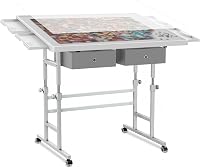
The ropoda 1500 Single-Pedestal Table adjusts from 26.9 to 36.4 in and tilts to 3 angles. It also has 6 drawers, locking swivel casters and a transparent cover sheet.
The SAIJI XX-Large Foldable Bed Tray has a 25.6 x 19.29 in surface and a fixed height of 10.6 in. Its legs fold, and the tray folds to 2 in thick for storage.
Those differences make them serve distinct needs. A table gives you a more dedicated work area, while a lap tray is easier to put away when the session ends.
How much room does your puzzle need?
Measure the puzzle and the area for loose pieces before choosing either surface. A tray that fits the assembled puzzle may leave little room to sort or build around it.
The ropoda table is described as a 1500-piece puzzle table. Its felt-topped wooden board helps keep pieces in place when tilted.
The SAIJI tray measures 25.6 x 19.29 in, so it is better suited to a smaller puzzle or a session where you don't need much extra sorting room. Measure your assembled puzzle, then allow space for edge pieces and sections still in progress.
For a portable puzzle surface with explicit capacity guidance, the Lavievert board fits puzzles up to 1000 pieces. Its board measures 30.71 x 20.87 in and comes with 4 sorting trays.
If your puzzle is large, compare its dimensions rather than relying on piece count alone. Puzzle sizes vary, so our guide to boards for 1000-piece puzzles explains what to measure.
Which setup is easier to move and store?
A lap tray folds away quickly; a puzzle board in a case is made to carry and store a puzzle. A wheeled table can move around a room, but it still needs a place to stand.
The SAIJI tray has foldable legs and folds to 2 in thick. It can sit on a bed, sofa, couch or floor, though its 10.6 in height doesn't adjust.
The Lavievert set includes a carry handle, a removable board and a padded case. Its 4 sorting trays can be stored in slots with hook-and-loop closures, and a pocket on the back can hold sorted pieces or finished sections.
The ropoda table has 4 swivel casters, each with a lock. Its transparent cover sheet helps protect an unfinished puzzle from dust, spills and curious pets, but the full table still takes floor space.
For a closer look at flexible tabletop options, see our guide to portable puzzle tables. If you mainly need a compact surface that rolls up between sessions, compare the trade-offs in our puzzle table or mat guide.
Which one suits your seating?
Choose a table if you want to set the working height; choose a tray if its fixed height matches your seat. The right fit depends on the distance from your hands to the puzzle and the support available beneath it.
The ropoda height range of 26.9 to 36.4 in gives you room to match different seating positions. Its 3 tilt angles let you change the board position, and its felt surface helps pieces stay put when angled.
A lap tray's fixed 10.6 in height may suit a bed or couch, but it won't adjust to your posture. Check that its legs fit around your lap or the surface below it, and that you can reach the whole puzzle without leaning over it.
If you prefer puzzling from a couch, our guide to puzzle tables for the couch covers fit and surface choices. For bed sessions, see how to puzzle in bed without losing pieces.
When does a tray need puzzle-specific storage?
Choose a puzzle board and case when you need to protect and carry an unfinished puzzle. A general-purpose lap tray gives you a surface, but it doesn't include the same puzzle storage features.
The Lavievert board has a padded case, removable board and 4 sorting trays. Those features suit a puzzle you want to put away or take along without leaving pieces loose on the tray.
The SAIJI tray has a small drawer for items such as pens, headphones and cables. It isn't described as a puzzle case, so plan a separate way to protect and store your puzzle if you choose it.
The ropoda table includes a transparent cover sheet for unfinished puzzles. Its drawers can separate pieces by shape or color, with 4 wooden drawers for puzzle pieces and 2 plastic drawers for smaller items.
If keeping a puzzle intact during a move is the main concern, our guide to moving an unfinished puzzle gives practical steps. It can also help you decide whether a cover, case or another support suits your setup.
Which is the better buy for your home?
Pick the option that fits your routine and has a clear place to live between sessions. The most useful surface is one you'll set up easily and can keep out of the way when needed.
Choose the ropoda if you puzzle often, have room for a dedicated table and want adjustable positioning. Choose the SAIJI if easy storage and flexible seating matter more than a larger puzzle workspace.
Choose the Lavievert if you want a portable board and case for puzzles up to 1000 pieces. For a broader overview of board styles and uses, read what a puzzle board is and how it works.
How should you make the final choice?
Choose by where you'll puzzle, how large the puzzle is and whether you need to store it unfinished. Those three checks narrow the options quickly.
Pick a puzzle table if it can stay set up and adjustable height, tilt, drawers or a cover would help your routine. Pick a lap tray if you need a smaller surface that folds away and fits your bed, couch or floor.
Pick a board in a case if carrying and storing an unfinished puzzle is central. Measure your puzzle and available space first, then compare those dimensions with the surface you plan to use.
Frequently asked questions
Is a puzzle table better than a lap tray?
A puzzle table is better for a dedicated setup, especially if you want adjustable height, tilt or drawers. A lap tray is easier to fold and put away, but its smaller surface and fixed height may limit puzzle size and seating options.
Can you do a jigsaw puzzle on a bed tray?
Yes, if the puzzle fits the tray and the surface stays level on your bed or couch. The SAIJI tray measures 25.6 x 19.29 in, so compare that usable area with your puzzle dimensions and leave room for loose pieces.
What should I use to store an unfinished puzzle?
Use a board and case designed to hold a puzzle if you need to move or store it between sessions. The Lavievert set has a removable board, padded case and 4 sorting trays, and fits puzzles up to 1000 pieces.
Do puzzle tables tilt?
Some do, but check the exact table before choosing one. The ropoda table has 3 tilt angles and a felt-topped board, while a general bed tray such as the SAIJI has a fixed-height surface.