How to Frame a Finished Jigsaw Puzzle
Measure the finished puzzle, secure its pieces, then place it in a frame with a matching opening and a protective front. Handle the puzzle on a firm surface and check that it lies flat before hanging.
On this page (7 sections)
- How do you frame a puzzle without shifting pieces?
- Should you glue a puzzle before framing it?
- How do you measure a finished puzzle for a frame?
- Which frame styles work for a finished puzzle?
- How do you load the puzzle into the frame?
- How do you move a puzzle before framing it?
- What should you check before hanging a framed puzzle?
To frame a puzzle, measure the finished puzzle, secure its pieces, then place it in a frame with a matching opening and protective front. Work on a firm, level surface and keep the puzzle supported while you move it.
The safest order is to decide how you’ll secure the pieces, choose a frame that fits the actual puzzle, then load and hang it. A frame that looks close in size can still leave a gap or press against the edges.
How do you frame a puzzle without shifting pieces?
Keep the puzzle flat and supported from below whenever you move it. If you need to lift or turn it, secure the pieces first with puzzle glue or adhesive saver sheets made for that use.
Check the frame’s instructions before loading. Some frames are designed for finished puzzles, while a standard picture frame may have a backing and clips that need careful handling.
Use a clean, dry work area with enough room to lay the frame parts out. Keep drinks, pets, and loose pieces away until the backing is closed.
Should you glue a puzzle before framing it?
Secure the puzzle before framing if it will be lifted, turned over, or hung as one piece. Glue and adhesive sheets are two common ways to hold the pieces together; follow the directions for the method you choose.
Puzzle glue can leave a surface coating, so use only a product intended for puzzles and apply it as directed. Adhesive sheets attach to the back, which can help keep the front image clear.
The QIKSION Puzzle Saver Sheets, 24 Pack, are adhesive sheets that can be trimmed to fit a puzzle. The pack includes 24 sheets and a scraper.
Don't lift the puzzle by one corner to test whether it is secure. Support the full piece with a board or ask someone to help carry it.
For a closer look at the tradeoffs, read puzzle glue vs saver sheets. If your puzzle needs turning before you apply adhesive, follow how to flip a puzzle over to glue the back.
How do you measure a finished puzzle for a frame?
Measure the completed puzzle itself, edge to edge, in both directions. Don't rely only on the piece count or the dimensions printed on the box.
Write down the width and height, then compare them with the frame’s stated puzzle fit or opening. Allow for any mat or border, since it reduces the space available for the puzzle.
A 50 by 70 cm frame and a 20 by 27 in frame are close in overall size, but they are not identical measurements. Check the frame’s fit details against your puzzle before buying.
Which frame styles work for a finished puzzle?
Choose a frame with a front cover and a backing that holds the puzzle flat. A frame made for puzzles may include a background sheet and hanging hardware; a standard frame can also work if its usable opening and backing suit your puzzle.
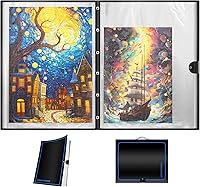
The MCS 20 by 27 Inch Puzzle Frame is designed for a 20 x 27 in finished puzzle or a smaller puzzle with a mat. It has a clear front, MDF backing, hinged hangers, and a two-sided cover stock sheet in black and white.
A standard frame option is the Giftgarden 50 by 70 cm Puzzle Frame. It has a metal frame, a plexiglass front, easy-open clips, and can be hung vertically or horizontally.
The upsimples 50 by 70 cm Puzzle Frame is another option for a puzzle close to that size. It has a plastic frame and cover, spring-action backing, and can be hung in either orientation.
For more ideas on holding a puzzle while you work, see jigsaw puzzle tables and boards. A table or board can also give you a flat place to assemble and prepare the puzzle.
How do you load the puzzle into the frame?
Lay the frame face down on a clean surface and place the supported puzzle into it without bending the edges. Follow the frame’s own steps for removing the backing and securing the clips or hangers.
If you glued or sheeted the puzzle, make sure it is fully set before you handle it. Slide a rigid board underneath when moving it, and avoid pinching the puzzle between your fingers.
Check the image orientation before closing the frame. If the frame includes a background sheet, choose the side that gives the puzzle a clear border without covering any pieces.
Before hanging, look at the back to confirm every clip is closed and the backing sits evenly. Use hanging hardware suited to the frame and wall, and keep the frame away from damp areas or direct heat.
How do you move a puzzle before framing it?
Move an unfinished or unsecured puzzle on a rigid support that keeps it level. Clear the route first, then carry the support with both hands and avoid tilting it.
If you need to turn the puzzle over to apply sheets, place a second board on top and sandwich the puzzle before flipping. A guide to how to move a puzzle without breaking it apart covers ways to support it in transit.
Don't try to slide a loose puzzle directly into a frame. Pieces can catch on the frame edge or separate as the puzzle bends.
What should you check before hanging a framed puzzle?
Confirm that the puzzle sits flat, the backing is closed, and the frame hangs in the intended direction. Recheck the wall hardware after hanging so the frame does not lean or shift.
A frame with a clear front can help keep dust off the puzzle, but it does not make a poor fit safe. If the puzzle bows or the backing presses unevenly, take it down and adjust the fit before displaying it.
For a simple decision, choose a puzzle frame when its intended size matches your measured puzzle and you want frame-specific features. Choose a standard 50 x 70 cm frame only after checking its usable opening against the puzzle dimensions.
If you are not ready to frame the puzzle, puzzle storage ideas for boxes, folders, and racks can help you keep it safe until you are.
Frequently asked questions
Should I glue a jigsaw puzzle before framing it?
Secure the pieces before framing if you plan to lift or hang the puzzle as one piece. Puzzle glue or adhesive saver sheets can do this; follow the product directions and let any glue dry fully.
If the frame will hold the puzzle flat and you can load it without lifting, securing it may not be needed.
How do I measure a finished puzzle for a frame?
Measure the completed puzzle from outer edge to outer edge in both directions, without including extra table space or the box dimensions. Compare those measurements with the frame's intended puzzle size or opening, and check whether a mat changes the usable space.
Can I frame a puzzle without glue?
Yes, if the frame supports the puzzle evenly and you can place it inside without bending or shifting pieces. A backing board and firm handling matter.
Secure the pieces first if you need to move the puzzle, turn it over, or hang it without a frame pressing across its surface.
What size frame fits a 1000-piece puzzle?
There is no single frame size for every 1000-piece puzzle because finished dimensions vary by brand and design. Measure yours after assembly, then match the frame's intended fit.
Some frames are made for 20 x 27 in or 50 x 70 cm puzzles, but confirm your puzzle's actual size.