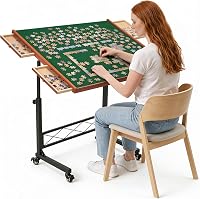
9 Best Jigsaw Puzzle Tables With Legs (November 2026)
The best jigsaw puzzle tables with legs include the BuilderButler 1500 Table with Wheels and Drawers (best overall), the ALL4JIG 1500 Table with Legs for solid wood build, and the JoyBerri Adjustable Height Puzzle Table for tall and short puzzlers.
On this page (10 sections)
- The best jigsaw puzzle tables with legs, by what you need
- How these puzzle tables compare
- How we compared these tables
- What size tabletop do you need for your puzzle?
- Which tilt range is right for you?
- Do you want wheels or fixed legs?
- How much drawer storage do you need?
- Wood, metal or plastic: which frame lasts?
- Which puzzle table with legs fits your room?
- The verdict
The best jigsaw puzzle table with legs for most homes is the BuilderButler 1500 Table with Wheels and Drawers. It tilts to 45 degrees, changes height from 26.77 to 36.22 inches and holds pieces in six drawers.
If you'd rather have a solid pine top and a simple set of tilt positions, the ALL4JIG 1500 Table with Legs, 3 Tilt Angles is the one to pick.
A freestanding table gives your puzzle its own home instead of the dining table. You can leave a half-finished 1500-piece build up for weeks, close the cover and walk away.
The picks below split by what you need most: a big surface, a steep tilt, a table you can fold away or one that rolls between rooms. If you're still weighing types, our jigsaw puzzle table guide covers boards, tabletops and tables in plain terms.
Our picks at a glance
-
1

-
2
 Best for solid wood build
ALL4JIG 1500 Table with Legs, 3 Tilt Angles
8.8/10 our score
See it on Amazon -
3
 Best for tall and short puzzlers
JoyBerri Adjustable Height Puzzle Table
8.7/10 our score
See it on Amazon
- 4
 Check it
ALL4JIG 1500 Table with Legs and Wheels
Best for steep drafting-style tilt - 5
 Check it
RAGOZONERY Puzzle Board 1500 Pieces
Best for folding flat and tucking away - 6
 Check it
HEBESPACE 1500 Metal Table with Legs
Best for one-handed tilt changes - 7Check it
BuilderButler 2000 Table with Wheels and Drawers
Best for large 2000-piece puzzles - 8
 Check it
HEBESPACE 2000 Metal Table with Drawers
Best for big puzzles with a metal frame - 9
 Check it
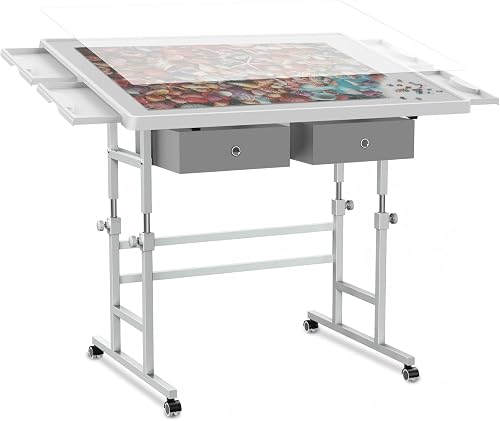
ALL4JIG 1500 Lightweight Plastic Tilting Table
Best for moving room to room
The best jigsaw puzzle tables with legs, by what you need
The BuilderButler 1500 wins for most buyers because it balances tilt, height and storage in one wooden table. Every other pick here solves a narrower problem better, so match the table to how you puzzle.
BuilderButler 1500 Table with Wheels and Drawers: Best overall
- Tilts up to 45 degrees
- Height from 26.77 to 36.22 in
- Six drawers
- Semi-transparent cover
A freestanding wooden table that tilts, changes height and stores pieces in six drawers. The locking castors let you move it and then hold it steady.
Pros
- 45-degree tilt and 26.77 to 36.22 in height range
- Four wooden drawers plus two deeper fabric drawers
- Two castors lock in place
Cons
- One of the heaviest wooden tables here at about 30 lb
- Wheels can let the table shift slightly under hand pressure
BuilderButler suits a spare room or corner where the puzzle stays up for weeks. The top tilts to any angle up to 45 degrees, so you can raise it partway for a comfortable look without pushing pieces off.
Height runs from 26.77 to 36.22 inches, which covers most dining chairs and sofas. Four castors make it easy to move, and two lock so the table holds still while you work.
Storage is the real strength: four wooden drawers plus two deeper fabric drawers, enough to sort by color and keep the edge pieces separate. The semi-transparent cover keeps dust, water and pets off the build, and the wooden frame gives it a furniture look rather than a craft-trolley one.
The trade-off is weight. At 13.68 kg (about 30 lb) it's one of the heaviest wooden tables here, so rolling beats carrying.
The non-slip felt surface helps, but a wheeled table can shift slightly under firm hand pressure. It's a table you set up once and then roll into position, not one you lift onto a couch.
ALL4JIG 1500 Table with Legs, 3 Tilt Angles: Best for solid wood build
- Three tilt angles plus flat
- Height from 28 to 34.5 in
- New Zealand pine top
- Four drawers and a cover
Pine construction with three set tilt angles rather than a free range. A good fit if you want a stable wooden top and a tidy set of positions.
Pros
- Sustainably sourced New Zealand pine
- Three tilt angles and flat
- Four drawers plus a translucent cover
Cons
- Only three tilt positions, not any angle
- Narrower height range than the BuilderButler
ALL4JIG's pine table suits buyers who want wood and a simple set of positions. The top locks at three tilt angles or lies flat, and the New Zealand pine resists warping and cracking over time.
Height adjusts from 28 to 34.5 inches using four screw buttons. That's a narrower range than the BuilderButler, so check it against your usual chair before committing.
The cold-press bonded top gives a flat, stable multi-layer surface for a 1500-piece puzzle. Four drawers slide out for sorting, and the translucent cover protects the build from dust and spills.
This table also has four universal castors with two lockable wheels. The pine legs and metal frame make it feel more solid than the plastic option further down, but the three fixed tilt angles mean you can't fine-tune the slope the way you can with an any-angle top.
The 24.53 by 33.19 inch top is slightly narrower than the BuilderButler's, so a very large 1500 piece puzzle leaves less sorting room at the edges.
Choose it if a wooden top matters more to you than a free-range tilt. Skip it if you need a height below 28 inches or a steeper drafting angle.
JoyBerri Adjustable Height Puzzle Table: Best for tall and short puzzlers
- Nine height settings from 21 to 37 in
- 45-degree tilt
- Four magnetic drawers
- Bonus 1000-piece puzzle and cover
The widest height span here, from 21 to 37 inches, so kids and tall adults can both find a comfortable seat. Felt surface and magnetic drawers keep pieces put.
Pros
- Nine height settings across a 16 in span
- Felt top stops pieces sliding
- Drawers lock to the desk with magnets
Cons
- Tilt stops at 45 degrees, not a full drafting range
- Green finish won't suit every room
JoyBerri is the pick for a household with both kids and tall adults. Nine height settings span 21 to 37 inches, a 16-inch range that's the widest here and low enough for a child's chair.
The top tilts to 45 degrees. A felt surface stops pieces sliding, and the four drawers attach with magnets so they stay put against the desk when you move the table.
The build mixes New Zealand pine, MDF and felt, which keeps it lighter than a solid pine table.
It comes with a protective cover and a bonus 1000-piece puzzle, which makes it an easy gift. Locking wheels let you push it out of the way and fix it in place.
The trade-offs are small: the tilt stops at 45 degrees, so it won't stand in as a drafting desk, and the green finish is a look you either like or don't. For a family room where several people puzzle at different heights, the height range alone earns it a place.
A 10-year-old at the lowest setting and a six-foot adult at the top can both work without stooping.
ALL4JIG 1500 Table with Legs and Wheels: Best for steep drafting-style tilt
- Tilt from 0 to 90 degrees
- New Zealand pine top
- Four drawers
- Four castors, two locking
The only table here that tilts all the way to 90 degrees, so it doubles as a drafting desk. Pine build with wheels and four drawers.
Pros
- Full 0 to 90 degree tilt range
- Lightweight frame at about 20.9 lb
- Four sliding drawers and a cover
Cons
- Needs assembly
- A steep angle sends loose pieces sliding without a raised lip
This ALL4JIG table suits someone who wants one table for puzzles and drafting. The top tilts from flat to 90 degrees, the only full drafting range in this group.
The New Zealand pine top resists warping, and the frame is built light at about 20.9 lb. That makes it easier for an older puzzler to move than the BuilderButler.
Four castors roll smoothly, and four sliding drawers pull out for sorting. A semi-transparent cover protects the build from dust and pets between sessions, and the reinforced legs are there to keep the table free of wobble.
The 90-degree limit is the catch for puzzling. At steep angles, loose pieces slide unless you add a raised lip or work with the cover partly on.
For flat or gently tilted puzzling, the pine surface and light frame are a good mix, and the 24.92 by 33.58 inch top holds a full 1500-piece jigsaw with a little room to spare.
Setup takes a few steps, so plan for an hour before your first puzzle. Pick it if you also want a drafting surface and don't mind assembly.
RAGOZONERY Puzzle Board 1500 Pieces: Best for folding flat and tucking away
- Folding legs
- Four drawers with metal clips
- Plastic protective cover
- Ready to use out of the box
Hardwood board on legs that fold away, so you can slide it under a sofa or bed between sessions. No tilt and no wheels, but the simplest table to store.
Pros
- Folding legs slide under furniture
- Four drawers with metal clips
- No setup needed
Cons
- No tilt or height adjustment
- No wheels, so you lift it to move it
RAGOZONERY suits a small flat where the puzzle table has to disappear between sessions. The hardwood board sits on legs that fold away, so you can slide the whole thing under a sofa or bed.
It's ready to use out of the box, with no setup. Four drawers have metal clips that stop them sliding out when you move the table, and a plastic cover keeps pets off the build.
The 34 by 26 inch top holds a 1500-piece puzzle with room to sort. The smooth surface lets pieces slide easily as you work, which helps when you're spreading out edges.
What you give up is adjustment. There's no tilt and no height change, and no wheels, so you lift it rather than roll it.
The board sits at 7.21 kg, which makes it easy to lift but means it relies on the legs to stay steady. For a dedicated flat table in a tight room, that's a fair trade.
Choose it when storage matters more than tilt.
HEBESPACE 1500 Metal Table with Legs: Best for one-handed tilt changes
- Pneumatic tilt from 0 to 30 degrees
- Height from 22.16 to 33.27 in
- Four drawers with non-slip liners
- Powder-coated iron frame
A metal-frame table where a one-touch pneumatic system sets the tilt. Lower tilt range than the wooden tables, but less effort to adjust.
Pros
- One-touch pneumatic tilt
- Drawer liners hold pieces when tilted
- Metal frame stays stable
Cons
- Tilts only to 30 degrees
- Assembly required
HEBESPACE's metal table suits anyone who finds lifting a tilted top hard on the arms. A one-touch pneumatic system sets the angle from flat to 30 degrees, so you press and it moves.
The 35.43 by 27.87 inch surface holds a 1500-piece puzzle. Height runs from 22.16 to 33.27 inches, and four castors with two locking wheels let you reposition it.
The drawers have non-slip liners that hold sorted pieces even when the table is tilted. A protective cover is included, and the powder-coated iron frame stays steady.
The 30-degree limit is the compromise. That's plenty for seated puzzling and easier on the neck than a flat table, but it won't tilt up for standing work.
Assembly is required, and the iron frame is a different look from the wooden picks, so it suits a modern or neutral room better than a traditional one. Pick it if you want the gentlest tilt adjustment here.
BuilderButler 2000 Table with Wheels and Drawers: Best for large 2000-piece puzzles
- 40.16 x 28.5 in top for 2000 pieces
- Tilts up to 45 degrees
- Six drawers
- Height from 26.77 to 36.22 in
The bigger BuilderButler gives 2000-piece puzzles the room they need. Same tilt, height range and drawer layout as the 1500 version, on a wider top.
Pros
- One of the widest tops in this group at 40.16 in
- 45-degree tilt and six drawers
- Two locking castors
Cons
- The extra width needs more floor space
- Heavier than the 1500 version
The 2000-piece BuilderButler suits a puzzler who works big. The top measures 40.16 by 28.5 inches, wide enough for a 2000-piece jigsaw with space to sort.
It carries the same tilt and height range as the 1500 version: any angle to 45 degrees, and 26.77 to 36.22 inches. Six drawers give you plenty of sorting room, with four wooden and two deeper fabric drawers.
Four castors with two locks make it movable, and the cover protects a build that will likely stay up for weeks. The non-slip felt surface helps hold pieces, and the wooden frame matches the smaller model.
The trade-off is floor space. At about 40 inches wide, it needs a bigger footprint than most of the picks here, and at 14.92 kg it's heavier than the 1500 BuilderButler.
Choose it only if you regularly build 2000-piece puzzles and have the room to leave it set up.
HEBESPACE 2000 Metal Table with Drawers: Best for big puzzles with a metal frame
- 41.34 x 29.53 in top for 2000 pieces
- Pneumatic tilt from 0 to 30 degrees
- Height from 22.16 to 33.27 in
- Four castors, two locking
The largest top here, in a metal frame with one-touch tilt. Suits a 2000-piece puzzle that stays up for weeks in one spot.
Pros
- Largest surface in this group
- Pneumatic tilt and locking castors
- Protective cover included
Cons
- At about 38 lb, the heaviest pick here
- 30-degree tilt limit
HEBESPACE's 2000-piece table has the largest surface in this group at 41.34 by 29.53 inches. That's room for a big puzzle plus sorting trays along the edge.
The pneumatic tilt runs from flat to 30 degrees. Height adjusts from 22.16 to 33.27 inches, and four castors with two locking wheels let you move it.
Drawers have non-slip liners for sorted pieces, and a cover shields the build. The iron frame is powder coated for a clean black finish that wipes down easily.
The downsides are weight and tilt. At about 38 lb it's the heaviest table here, so moving it takes some effort.
The 30-degree limit suits seated puzzling but not standing work, and it tops out at 29.53 inches deep, so it's a footprint to plan around. Pick it for the biggest possible surface in a metal frame, in a spot where it can stay.
ALL4JIG 1500 Lightweight Plastic Tilting Table: Best for moving room to room
- ABS plastic top and frame
- 45-degree tilt
- Height from 27.16 to 35.82 in
- Four drawers and a cover
The lightest wheeled table here at about 25 lb, built from recyclable ABS plastic. Easy to push between rooms, though it feels less solid than wood.
Pros
- Lightest wheeled pick in this group
- 45-degree tilt and four drawers
- Eco-friendly recyclable plastic
Cons
- Plastic won't match a wooden room
- Less sturdy feel than the wooden tables
This ALL4JIG table suits someone who moves the puzzle from room to room. At 11.29 kg (about 25 lb) it's the lightest wheeled table here, built from recyclable ABS plastic.
The top tilts to 45 degrees and the height runs from 27.16 to 35.82 inches. Four drawers move with the tabletop angle, so sorted pieces stay within reach when you raise the top, and each has a handle that keeps it shut in transit.
Four universal castors with two locks let you roll it easily and fix it in place. A semi-transparent cover and a non-slip felt surface are included.
Plastic is the compromise. It won't match a wooden room and feels less solid than the pine tables when you lean on it.
Choose it if portability beats a wood finish.
How these puzzle tables compare
The comparison table lines up surface size, tilt range, height range, storage and mobility so you can match a table to your room and your puzzle size. Read it top to bottom for the two or three tables that fit your space, then check the write-up above for the trade-offs.
| Product | Best for | Puzzle capacity | Top size | Frame | Our score |
|---|---|---|---|---|---|
| BuilderButler 1500 Table with Wheels and Drawers | overall | 1500 pieces | 33.58 x 24.92 in | Wood | 8.9 |
| ALL4JIG 1500 Table with Legs, 3 Tilt Angles | solid wood build | 1500 pieces | 24.53 x 33.19 in | Metal frame, pine legs | 8.8 |
| JoyBerri Adjustable Height Puzzle Table | tall and short puzzlers | 1500 pieces | 35 x 26.5 in | New Zealand pine, felt and MDF | 8.7 |
| ALL4JIG 1500 Table with Legs and Wheels | steep drafting-style tilt | 1500 pieces | 24.92 x 33.58 in | Wood | 8.6 |
| RAGOZONERY Puzzle Board 1500 Pieces | folding flat and tucking away | 1500 pieces | 34 x 26 in | Hardwood | 8.5 |
| HEBESPACE 1500 Metal Table with Legs | one-handed tilt changes | 1500 pieces | 35.43 x 27.87 in | Iron | 8.5 |
| BuilderButler 2000 Table with Wheels and Drawers | large 2000-piece puzzles | 2000 pieces | 40.16 x 28.5 in | Wood | 8.5 |
| HEBESPACE 2000 Metal Table with Drawers | big puzzles with a metal frame | 2000 pieces | 41.34 x 29.53 in | Iron | 8.3 |
| ALL4JIG 1500 Lightweight Plastic Tilting Table | moving room to room | 1500 pieces | 25.59 x 34.25 in | ABS plastic | 8.2 |
Size matters more than any other row. A 40 inch top holds a 2000-piece puzzle; a 34 inch top holds 1500 with sorting room.
Tilt and height decide comfort, and drawer count decides how organized you can stay. If two tables tie on size, the one with the wider height range usually wins for shared use.
How we compared these tables
Our score weighs specs, features and buyer feedback against what you're shopping for. We compared surface size against 1000, 1500 and 2000-piece counts, then weighed tilt range, height range, drawer count, cover, frame material and whether the table rolls or stays put.
A table that fits a 2000-piece puzzle needs about 40 inches of width, so we scored the 2000-piece models down where the extra size came with real weight or floor-space costs. Wood tops scored higher for stability, plastic for portability.
Pneumatic tilt earned credit for ease of use even where the angle range was shorter, and we marked down tables with no tilt or no height change where another pick did both. Scores run from 8.2 to 8.9 so the gaps reflect real differences.
What size tabletop do you need for your puzzle?
Match the top to your puzzle count: about 30 by 22 inches for 1000 pieces, 34 by 26 inches for 1500 and 40 by 28 inches for 2000. Add a few inches on each side if you sort pieces on the table.
Every pick here states a piece count, but piece count only tells part of the story. Puzzle brands vary in piece size, so a large-piece 1000-piece jigsaw can need more room than a standard one.
Measure the finished puzzle size on the box before buying. Then compare it with the tabletop dimensions in the comparison table above.
A top that's only just big enough leaves no room to lay out pieces as you sort.
Best size for 1000-piece puzzles
A 30 by 22 inch top is enough for a 1000-piece puzzle with modest sorting space. Every table in this group is larger than that, so you'll have room to spare.
Several picks also double as a laptop table or card table between puzzles.
Best size for 1500-piece puzzles
Look for a top around 34 by 26 inches. The BuilderButler 1500, ALL4JIG 1500 models, JoyBerri and HEBESPACE 1500 all sit close to that.
The JoyBerri at 35 by 26.5 inches and the HEBESPACE at 35.43 by 27.87 inches give the most margin.
Best size for 2000-piece puzzles
Go for 40 inches wide or more. The BuilderButler 2000 and HEBESPACE 2000 are the two picks built for that size, at 40.16 and 41.34 inches wide.
Both need a room where the table can stay.
Which tilt range is right for you?
For seated puzzling, 20 to 30 degrees is the useful range and covers most people. Anything steeper suits drafting or standing work rather than a jigsaw.
A small tilt takes strain off your neck without sending pieces sliding. That's why the HEBESPACE tables stop at 30 degrees: it's enough for comfortable seated work.
Tables that reach 45 degrees give you more room to fine-tune. The BuilderButler, JoyBerri and ALL4JIG 1500 plastic top all top out there.
Our tilting puzzle table guide goes deeper on angle choices.
When you want a steep drafting tilt
Only the ALL4JIG 1500 Table with Legs and Wheels goes to 90 degrees. Pick it if the same table needs to serve as a drafting desk.
For puzzling alone, a 45-degree top is plenty, and the extra range mostly helps when you stand and work.
Do you want wheels or fixed legs?
Wheels suit a table you move between rooms or tuck away often, while fixed legs give a firmer surface. Almost every pick here rolls, so the real choice is whether you need that movement.
A rolling table with locking castors gives you both: move it when you want, lock it when you puzzle. That's how the BuilderButler, JoyBerri, ALL4JIG and HEBESPACE models work.
Two locking wheels per table is the norm here.
Fixed or folding legs make more sense in a small room. The RAGOZONERY board folds flat and slides under furniture, which no wheeled table here can do.
For a wider look at moving options, see our puzzle table on wheels roundup.
When folding legs beat wheels
Choose folding legs when your only storage is under a sofa or bed. Wheels roll across a floor but still need a parking spot, while a folding board goes flat.
The RAGOZONERY board also stores more compactly than any fixed-leg table here.
How much drawer storage do you need?
Four drawers is the sweet spot for a 1500-piece puzzle, enough for color groups plus edges. The BuilderButler tables go further with six drawers for bigger sorting jobs.
Drawers matter most on a tilted table. Sorted pieces stay in reach as the top rises, which is why the ALL4JIG plastic table moves its drawers with the angle and the HEBESPACE models line theirs with non-slip material.
A drawer that slides out when the top is raised spills your sorting work, so clips and handles count.
Drawer counts in this group
Four drawers cover the ALL4JIG models, JoyBerri, RAGOZONERY and both HEBESPACE tables. The two BuilderButler models carry four wooden drawers plus two deeper fabric drawers.
If you sort by color rather than by edge, those two extra drawers give you room for a 2000-piece build without stacking trays on top.
Wood, metal or plastic: which frame lasts?
Wood and metal frames give the steadiest surface for long puzzling sessions, while plastic wins on weight. For a table that stays up for weeks, pick wood or metal.
The pine tables from ALL4JIG and JoyBerri resist warping and cracking. The powder-coated iron frames from HEBESPACE stay stable and easy to wipe clean.
Plastic is lighter and easier to move, and the ALL4JIG ABS top is recyclable. It just won't match the solid feel of wood when you lean on the table.
A hardwood board like the RAGOZONERY sits between the two: simple and solid, but with no adjustment.
Who should choose each frame
Pick wood for a dedicated puzzle room. Pick metal for a modern room and easy cleaning.
Pick plastic if you move the table often or need something light for an older puzzler.
Which puzzle table with legs fits your room?
Measure your floor space before you buy: the largest picks here need about 5 by 4 ft including chairs and sorting room. A small spare room suits the folding RAGOZONERY board better than a 2000-piece table.
Also check the height against your usual seat. A table set too high or too low brings back the neck strain you bought it to avoid.
For more on matching a table to a room, our folding puzzle table guide covers the space-saving options.
Small rooms and shared living spaces
Choose folding legs or a 1500-piece top. Leave the 2000-piece tables for a room where the puzzle can stay put.
The JoyBerri's low 21 inch setting also helps when the table has to sit in a living room where kids use it.
A dedicated puzzle room
A 2000-piece table with six drawers gives you the most working room. The BuilderButler 2000 is the pick if you want drawers, while the HEBESPACE 2000 wins on surface size.
The verdict
Buy the BuilderButler 1500 Table with Wheels and Drawers if you want one table that tilts, adjusts and stores everything. It's the best jigsaw puzzle table with legs for most homes because no other pick here combines a 45-degree tilt, a wide height range and six drawers at this score.
Pick the ALL4JIG 1500 with 3 tilt angles for a solid pine top and fixed tilt positions. Choose JoyBerri if short and tall puzzlers share the table, or the ALL4JIG with wheels and legs if you also want a drafting desk.
For a big build, the BuilderButler 2000 gives you the width; for a table that folds away, the RAGOZONERY board is the one to buy.
Whichever you choose, set the height to your chair first, then set the tilt. That order gets you a comfortable position before you tip the top.
Our top 3 picks at a glance
-
1
-
2
Best for solid wood build
ALL4JIG 1500 Table with Legs, 3 Tilt Angles
8.8/10 our score
See it on Amazon -
3
Best for tall and short puzzlers
JoyBerri Adjustable Height Puzzle Table
8.7/10 our score
See it on Amazon
Frequently asked questions
How much floor space does a puzzle table with legs need?
Plan for the tabletop footprint plus about 2 ft around it for chairs and piece sorting. The largest pick here is about 41 by 30 in, so allow roughly 5 by 4 ft in total.
Can I leave a puzzle out on a table with legs for weeks?
Yes, if the table has a cover. Most picks here include a semi-transparent cover that shields pieces from dust, spills and pets between sessions.
Do puzzle tables with legs fit under a sofa or bed?
Only the folding-leg models do. The RAGOZONERY board folds flat enough to slide under a sofa or bed, while fixed-leg tables stay in place.
What tilt angle works best for puzzling?
20 to 30 degrees takes strain off your neck for most seated puzzlers. Steeper angles up to 45 or 90 degrees suit drafting or standing work better.
How do I stop pieces sliding when the table is tilted?
A non-slip felt top or drawer liners help most. Felt grips piece edges, and liners keep sorted pieces in place when the tabletop is raised.
Is a wheeled or fixed-leg puzzle table better?
Wheels suit a table you move between rooms or tuck away often. Fixed legs give a firmer surface for a puzzle that stays up in one spot.